


long-form videos
Coming Soon
SHORT-FORM VIDEO
you are not a mind that happens to have a body
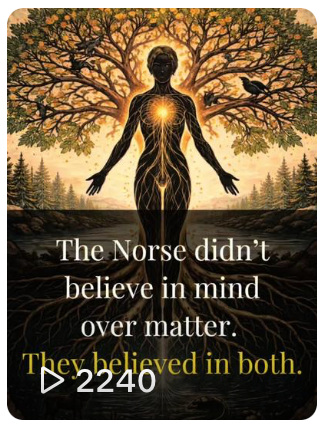
One of the deepest assumptions of the modern world is that the self lives somewhere inside, in the mind, the psyche, the inner life, and that the body is the vehicle it moves around in. These traditions did not recognise that split.
The self was not housed in the body. It was distributed across it, entangled with it, expressed through it. Mind and body were not two things in a relationship. They were one system, and understanding yourself meant understanding that system in its entirety: what it was capable of, what it was connected to, and what happened when you pushed it past its limits.
norse tradition
hamr,
hugr,
fylgja
and the shape of the self
Norse tradition held that the self was composed of multiple elements that could, under certain conditions, come apart. The hamr was the shape or skin; not just the physical body but the form the self took in the world, which a skilled practitioner could alter. The hugr was something closer to mind or spirit; the animating force that could travel, that others could sense approaching before you arrived, that persisted in some form after death. The fylgja was a companion spirit, often animal in form, that accompanied a person through life and whose condition reflected theirs.
These were not metaphors. They were a working model of the self as a system with multiple components, some more fixed than others, all in relationship with the world outside. Shape-shifting in Norse tradition (Odin moving as eagle or serpent, Loki transforming across species and sex) was the sharpest expression of this: identity as something that could be worn differently, that was not permanently fixed to a single form. The practice of seiðr involved precisely this kind of boundary-crossing, moving between states, between forms, between identities. It was transgressive, powerful, and treated with serious respect.
The self as breath,
Shadow, and
Song
FINNISH KALEVALA
Finnish tradition held its own model of the distributed self. The henki (breath, spirit, life-force) was the animating principle that left the body at death and could be endangered during illness or crisis. The luonto was a person’s nature or innate power; something you were born with but could cultivate, something that made you more or less effective as a healer, a singer, a craftsperson.
The tietäjät worked explicitly with this understanding: their power came not just from knowledge but from the cultivation of their own luonto, their capacity to move between states, to enter the boundary zones where the forces they needed to work with could be reached.
The body in Finnish tradition was the instrument through which all of this moved; the sung word required breath, required a body, required physical presence. Knowledge and power were not purely mental. They were somatic, carried in the body as much as the mind.
WHAT we lost
The separation of mind from body that characterises most of modern life would have been genuinely foreign to these traditions. We treat the body as something to be optimised, maintained, or transcended; a vehicle for the self rather than a constituent part of it. We locate identity in the internal, the psychological, the self-defined - and treat the body’s signals, its rhythms, its responses to the world as noise to be managed rather than information to be read.
The cost of that separation shows up in the ways we exhaust bodies while expecting minds to keep performing, ignore physical states while trying to address psychological ones, and treat the loss of physical capacity as somehow separate from the loss of self. These traditions would have found all of that not just philosophically wrong but practically incoherent. You cannot tend the hugr while ignoring the hamr. The system doesn’t work that way.
and what it cost us
IF THIS IS YOUR BELIEF System -
What does it mean for your life?
Across Norse and Finnish tradition, the self was not a single, fixed, internal thing. It was multiple, permeable, and partly constituted by forces outside the individual entirely. You were connected to your ancestors, your community, the land you came from, and forces that moved through you in ways you could cultivate but not entirely control. Identity was not something you discovered by looking inward. It was something you enacted - through your conduct, your commitments, your physical presence in the world, and your relationship with the forces that shaped you.
1. The body Is not the container for your self - it is part of what your self is
3. The boundaries of the self are more permeable than we tend to assume.
The Norse model of hamr, hugr, and fylgja distributes the self across multiple registers, all of which matter. What you do with your body, how you inhabit it, what condition you keep it in - these are not separate from who you are. They are part of how you are present in the world, and they affect everything else in the system.
These traditions located the self partly in conduct, partly in community, partly in the physical presence you brought to the world. Who you are is not only what you believe about yourself internally. It is what you do, repeatedly, in relationship with others - and that enactment happens through a body, in a specific place, among specific people.
The fylgja connects you to forces beyond yourself. The hugr can be sensed by others before you arrive. Your luonto is shaped by what you came from as much as what you choose. These traditions held that the self is not a sealed unit. It is a node in a network — shaped by ancestors, community, land, and forces that move through you whether you acknowledge them or not.
Odin moves as eagle and serpent. Loki crosses every boundary the tradition draws. This is not presented as confusion or dissolution of self. It is presented as capacity: the ability to move through different forms, different states, different modes of being, while remaining coherent. The question these traditions raise is not which fixed form you really are. It is how fully you can inhabit the range of what you are capable of being.
2. Identity is enacted, not just felt.
4. Shape-shifting is not the loss of Identity - it is the full use of it.