



long-form videos
Coming Soon
SHORT-FORM VIDEO
THE WORLD WAS NEVER A BACKDROP
In the modern world, nature is something you visit. You go outside, you take in the view, you come back in. These traditions had no framework for that relationship because the distinction it relies on - between you and the natural world, between inside and outside - didn’t exist in the same way.
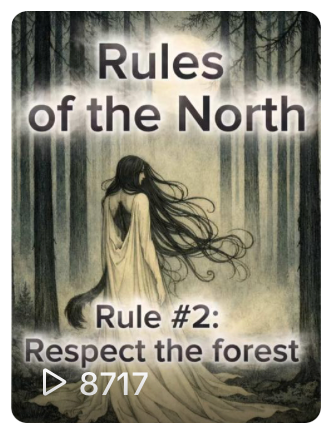
The forest, the sea, the winter, the land were not backdrop. They were participants. They had agency, personality, and expectations. You were not observing nature from a safe distance. You were in a relationship with it, and like all relationships, that one had obligations running in both directions.
Norse cosmology is built inside a nature that is actively hostile and must be continuously negotiated with. The sea is Rán’s domain and she takes what she wants. The winter is not a season to be waited out but a force with its own logic and demands. Yggdrasil, the world tree, holds everything together, and its health is everyone’s concern; the serpent Níðhöggr gnaws at its roots continuously, and the maintenance of the tree requires ongoing effort and attention.
The Norse relationship with the land was shaped by the actual conditions of Scandinavian survival: short growing seasons, brutal winters, seas that were both highway and graveyard. The mythology reflects this without romanticising it. Nature in Norse tradition is not gentle. It is powerful, indifferent to your preferences, and worthy of serious respect precisely because of that.
The forest as the
centre
of the world
FINNISH KALEVALA
Across Norse, Finnish, and Sámi tradition, the natural world was understood as animate - not metaphorically, but structurally. Forces that governed weather, water, forest, and land were beings with whom you could negotiate, whom you could offend, whose favour mattered practically and immediately.
This was not primitive superstition dressed up as religion. It was a sophisticated framework for living inside systems that could kill you, developed over thousands of years by people who understood those systems with extraordinary intimacy. The reciprocity it demanded, give something back, take only what you need, acknowledge what you are drawing from, was not sentiment. It was survival logic.
norse tradition
In Finnish tradition, the forest was not wilderness in the sense of something untamed and apart. It was the primary world: the place where most of life happened, where food came from, where the spirits that governed daily existence resided.
The metsänhaltija, the forest guardian, had to be acknowledged before you hunted or felled trees. The bear held a position of such cosmological significance that killing one required elaborate ritual to manage the relationship between the human and animal worlds. The Kalevala is saturated with this orientation: Väinämöinen does not move through nature as a hero conquering a landscape. He moves through it as someone who knows its names, its origins, its synty - and that knowledge is what gives him standing within it.
Finnish tradition understood the natural world as something you had to know deeply and treat carefully, because it was always paying attention.
A world
that pushes back
Sámi relationship with the natural world went further still - or perhaps more precisely, it never developed the distance from it that even Norse and Finnish traditions eventually acquired.
The Sámi cosmology of siida, the community unit organised around reindeer and the land, was built on the understanding that human survival and the health of the natural world were not separate concerns. The noaidi, the Sámi shaman, moved between the human and natural worlds as a matter of practical necessity, maintaining relationships with the forces that governed both. Animals were not resources. They were relatives, in a sense precise enough to carry obligations. Taking from the natural world required acknowledgment, gratitude, and reciprocity; not as ritual formality but as the actual mechanism by which the relationship stayed intact.
the Sámi
tradition
Reciprocity
as the foundation
of everything
WHAT we lost
The reciprocity these traditions considered basic, the acknowledgment that you are drawing from something that has its own integrity and deserves something back, has been almost entirely severed in the way most of us live now. We extract without acknowledging. We consume without reciprocating. We have replaced relationship with management, and we treat the consequences of that severance as technical problems to be solved rather than relational failures to be repaired.
These traditions would not have been surprised by where that leads. They would have recognised it immediately as what happens when you forget that the world you live inside is paying attention - and has its own capacity to respond.
and what it cost us
IF THIS IS YOUR BELIEF System -
1. Reciprocity is not sentiment - it is the structure of a sustainable relationship.
Every tradition covered here understood that you cannot take without giving back, extract without acknowledging, use without maintaining. This was not philosophy. It was the practical logic of people who lived inside systems they depended on completely. The question is whether you are living as though the systems you depend on have that same integrity — because they do, whether you acknowledge it or not.
∙
Rán takes the drowned. The metsänhaltija notices what you take from the forest. The noaidi maintains relationships with forces that govern survival. These traditions encoded a truth that is easy to lose from inside a heated building with a supermarket nearby: the world you live in is not inert, and your relationship with it is not optional.
3. Knowing the names of things is the beginning of being in Relationship with them.
2. The natural world has agency. Treating it as though it Doesn't is a choice with consequences.
Väinämöinen’s power comes from knowing the synty of the world around him. The Sámi relationship with land and animal was built on knowledge so intimate it took generations to accumulate. You cannot be in genuine relationship with something you don’t know. The recovery of that knowledge — what grows where, what the land around you actually is, what you are drawing from — is the first step back toward the reciprocity these traditions considered basic.
These traditions were shaped by environments that demanded genuine toughness — not performed hardship, but the actual capacity to meet difficulty without being destroyed by it. That capacity came from relationship with the natural world, not insulation from it. The further you get from that relationship, the more fragile you become in ways that are easy not to notice until the systems you’ve been depending on stop working.
What does it mean for your life?
4. Comfort is not the same as resilience.